
The new Machinery Regulation 2027 replaces the Machinery Directive 2006/42/EC, on which every CE marking in mechanical engineering has been based so far. From January 20, 2027, Regulation (EU) 2023/1230 applies directly in Austria, Germany and all other EU member states. Many overviews list the new requirements. For manufacturers, however, a different question is decisive: Which changes create real effort in design and documentation, and where will existing CE documentation no longer suffice after the cutoff date? I answer that question in this article, with references to the specific articles and annexes of the Regulation.
I describe the overall process of CE marking for machinery on a separate page.
When does the Machinery Regulation 2023/1230 apply?
The Regulation was published in the Official Journal on June 29, 2023, and entered into force on July 19, 2023. It generally applies from January 20, 2027 (Art. 54(2)). On the same day, Directive 2006/42/EC is repealed (Art. 51(2)) [1].
One detail keeps causing confusion: the originally published version contained incorrect dates, such as January 14, 2027. A corrigendum dated July 4, 2023 corrected all dates [2]. If you still find January 14 in older documents or presentations, you are working with an outdated text.
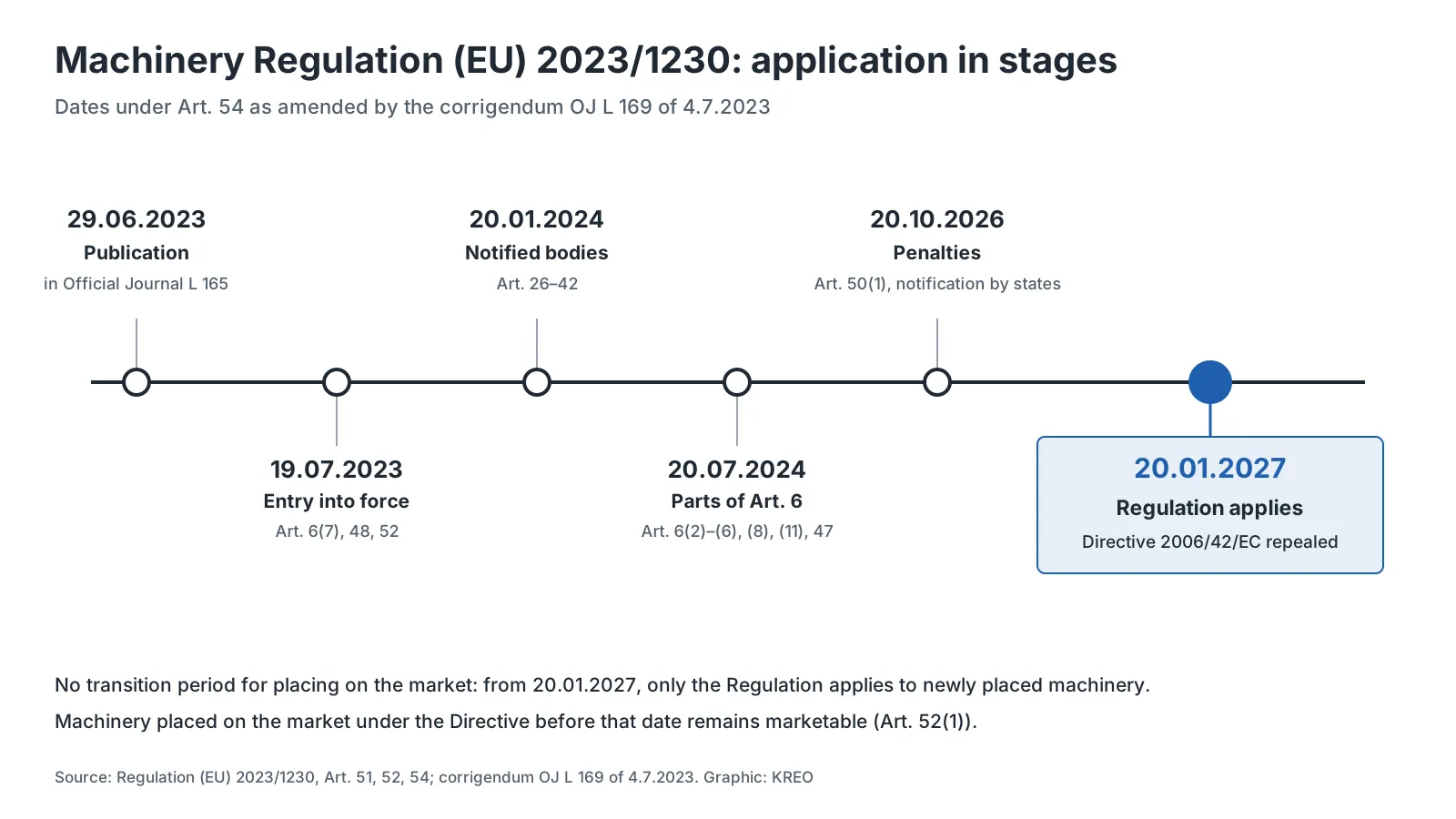
Some parts already apply earlier, above all the provisions on notified bodies (since January 20, 2024) and the obligation of member states to lay down penalties and notify them to the Commission by October 20, 2026 (Art. 50, Art. 54(3)) [1].
No transition period for placing on the market
The most important point for planning: there is no transition period in which manufacturers can choose. Machinery placed on the market under the Directive before January 20, 2027 remains marketable (Art. 52(1)). Every machine placed on the market for the first time from that day on must comply with the Regulation [1].
What counts is placing on the market, not the date of the order or of the design. A special-purpose machine designed in the fall of 2026 and delivered to the customer in February 2027 falls under the Regulation. For long-running projects, the requirements specification should therefore already state which set of rules the acceptance will be based on. If this only comes up during commissioning, acceptance is delayed, and the cost of subsequent changes is usually borne by the manufacturer.
The key changes of the “new Machinery Directive” at a glance
Colloquially, people often speak of the “new Machinery Directive.” Legally, the switch from a directive to a regulation is itself a change: the Regulation applies directly, without transposition into national law. The essential health and safety requirements are now in Annex III (previously Annex I of the Directive). Annex I of the Regulation, by contrast, lists the categories of machinery subject to a special conformity assessment procedure.
The following table groups the changes by where they create work in the company. The classification is an assessment from a design perspective, not a legal evaluation.
| Change | Reference | Who it mainly affects | Where the effort arises |
|---|---|---|---|
| Regulation instead of directive, new annex numbers | Art. 51, Annex III | all manufacturers | Cross-references in risk assessment, declaration, instructions |
| New categories requiring a notified body | Annex I Part A, Art. 25 | Manufacturers of machinery with self-learning safety functions | Certification, scheduling |
| Protection against corruption (cybersecurity) | Annex III 1.1.9 and 1.2.1 | Machinery with network connection, remote maintenance | Control architecture, software documentation |
| Digital instructions for use and declaration of conformity | Art. 10(7) and (8) | all manufacturers | Availability for at least 10 years |
| Definition of substantial modification | Art. 3(16), Art. 18 | Operators, modifiers, integrators | Assessment of every modification |
| Obligations for importers and distributors | Art. 13 to 17 | Importers, distributors | Checks before distribution |
Source: Regulation (EU) 2023/1230 [1]. The effort assessment is a guideline and depends on the machine type and the existing documentation.
New high-risk categories and conformity assessment
Annex I is divided into two parts. Part A comprises six categories, including removable mechanical transmission devices, vehicle lifts and, new, safety components and machinery with fully or partially self-evolving behavior using machine learning approaches that ensure safety functions. Part B comprises 19 categories, such as presses, injection molding machines and logic units to ensure safety functions [1].
The difference lies in the procedure (Art. 25). For Part A, a notified body must always be involved, even if the manufacturer fully applies harmonized standards. For Part B, internal control (Module A) remains permissible only if harmonized standards or common specifications cover all relevant requirements and are fully applied [1].
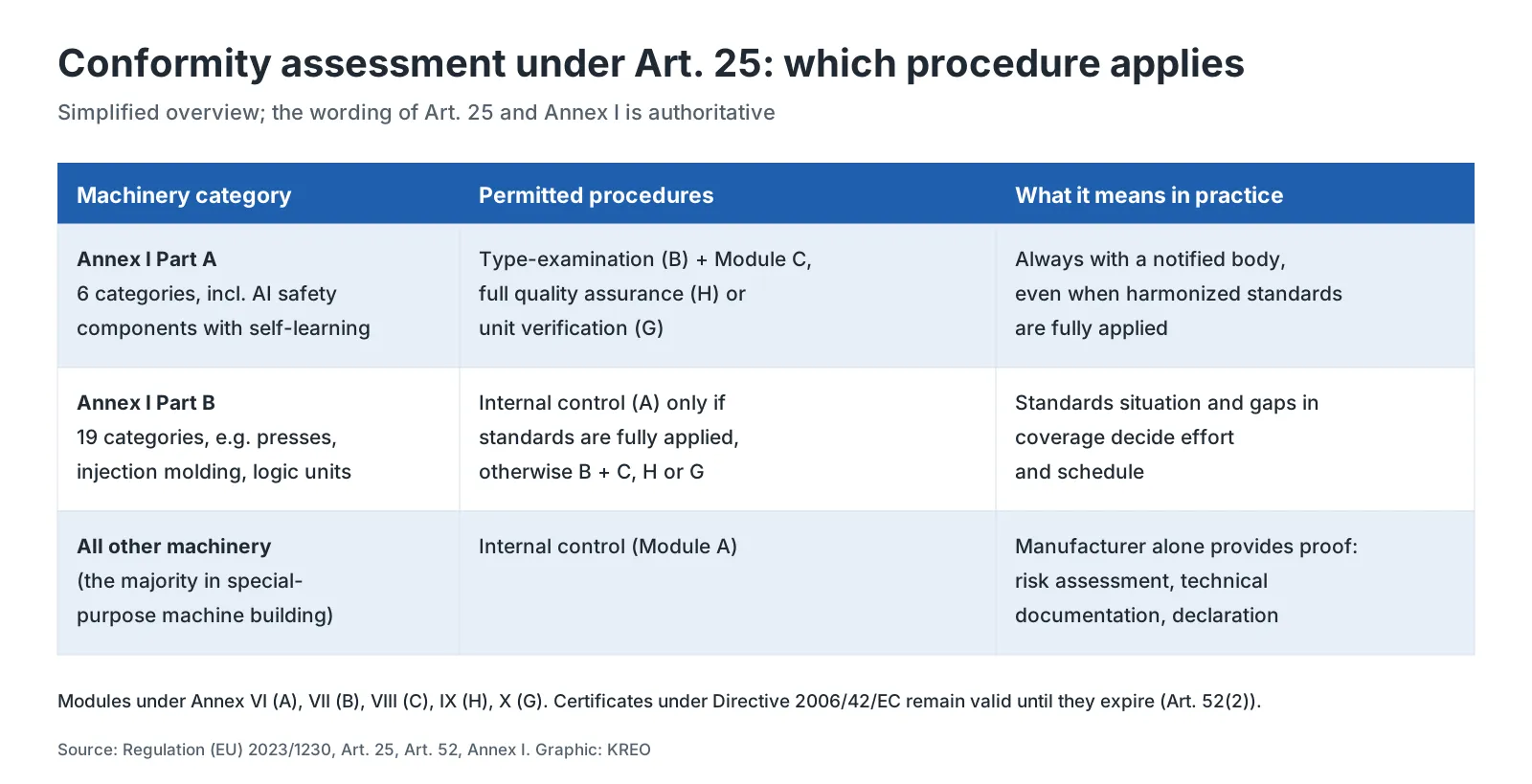
In practice, the Part B case is underestimated. “Fully applied” means: every relevant requirement covered by a listed standard, without deviation. If the design deliberately deviates at one point, for example because a protective device is implemented differently than described in the type C standard, the machine no longer qualifies for internal control. A notified body is then required, with the corresponding lead time. This decision is made in design, not in documentation.
Existing EC type-examination certificates remain valid until they expire (Art. 52(2)) [1].
Cybersecurity: protection against corruption
The Directive had no requirement for IT security. The Regulation introduces two. Under Annex III 1.1.9, connecting to other devices or remote access must not lead to a hazardous situation. Safety-relevant hardware, software and data must be protected against corruption, and the machine must collect evidence of legitimate and illegitimate interventions. Under 1.2.1, control systems must withstand reasonably foreseeable malicious attempts by third parties. Evidence of interventions and versions of the safety software must be kept for five years [1].
This sounds like an IT topic, but it affects the design. Whether a remote maintenance access acts directly on the safety controller or is cleanly separated is decided in the control architecture. A missing separation can often only be fixed afterward with additional hardware, and then the validation of the safety functions changes as well.
Digital instructions for use
The instructions for use may be provided digitally in the future. They must be downloadable, printable and storable, and remain available online for the lifetime of the machine, but for at least ten years. If the purchaser requests a paper version at the time of purchase, it must be supplied free of charge within one month. For non-professional users, the safety information must be supplied on paper (Art. 10(7)). The EU declaration of conformity can also be provided via a web address or a machine-readable code (Art. 10(8)) [1].
The effort here lies not in creating the documents but in keeping them available. Ten years is longer than the lifetime of many websites and document portals. For a young company or a builder of special-purpose machinery with only a few units per year, this is an organizational question that must be settled before the first digital instructions.
Substantial modification is defined for the first time
For operators and modifiers, this is the change with the greatest consequences. The Directive contained no definition; people worked with national interpretation guides. Now Art. 3(16) defines substantial modification as a physical or digital modification after placing on the market that was not foreseen by the manufacturer, that creates a new hazard or increases an existing risk, and that therefore requires either the addition of protective devices with an adaptation of the safety-related control system or additional protective measures to ensure stability or mechanical strength [1].
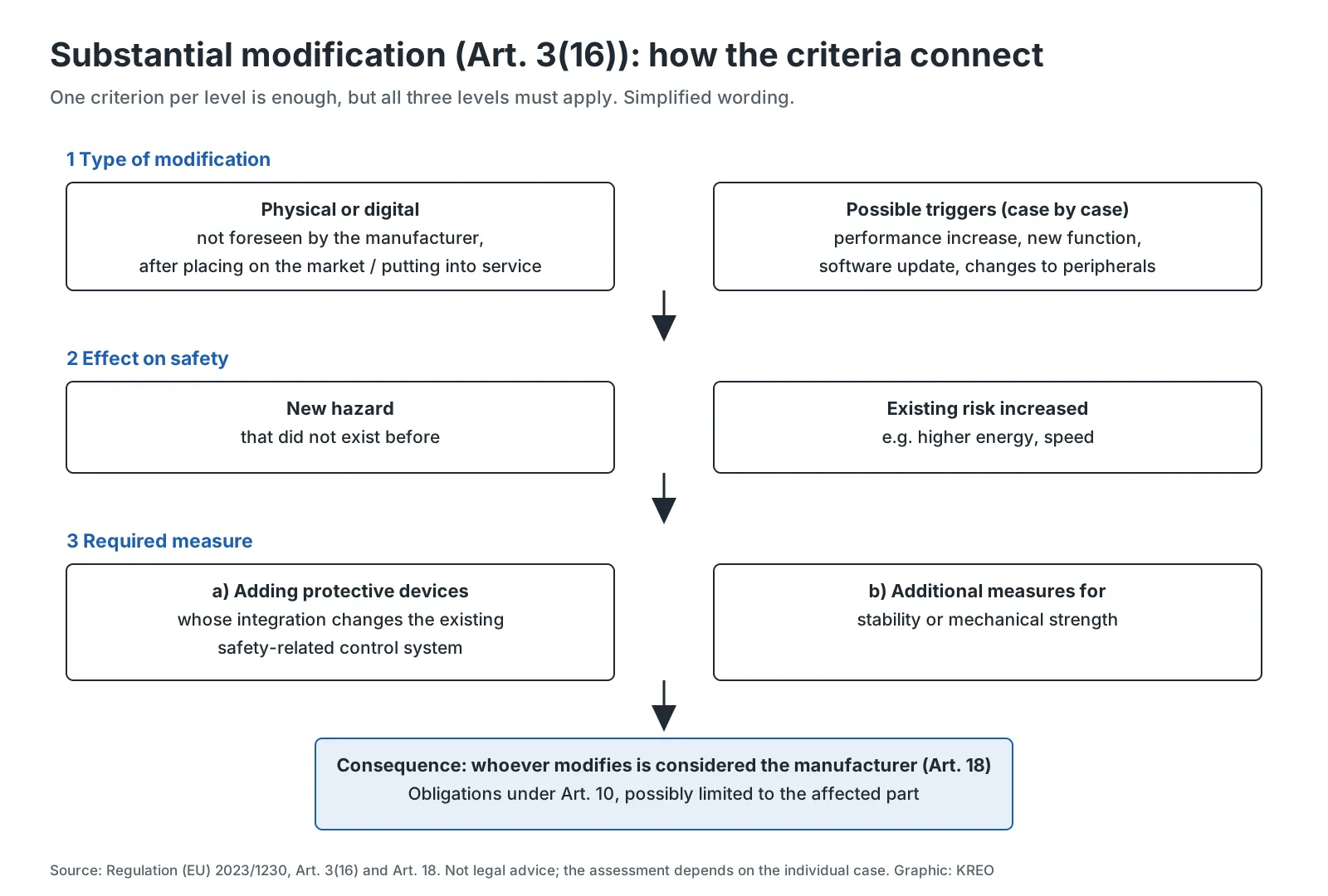
Whoever substantially modifies a machine is considered the manufacturer and takes on the manufacturer’s obligations. If the modification affects only part of an assembly of machinery, the obligations are limited to that part (Art. 18) [1].
The word “digital” is noteworthy. A software update that increases speeds or changes a safety function can therefore be a substantial modification, even if nothing in the mechanics was changed. In practice, the borderline cases are the difficult ones: a faster handling device in an existing cell increases the kinetic energy, but the existing guard may still be sufficient. Criterion 3 would then not be met. Whether that is the case can only be demonstrated with a traceable risk assessment, not with a blanket rule.
What changes for manufacturers, modifiers and importers
The roles in the Regulation are more clearly assigned than before. What this means for each party depends heavily on which machinery they build or distribute and how their documentation is structured today.
Manufacturers continue to bear the main responsibility (Art. 10). What is new above all is that the risk assessment and the technical documentation must be aligned with the requirements of Annex III, including the new points on cybersecurity, psychological stress (1.1.6) and testability of safety functions (1.1.2). The technical documentation and the declaration must be kept for at least ten years (Art. 10(3)) [1]. Anyone who continues to deliver an ongoing product series from 2027 needs an assessment under the Regulation for that series. A copy of the old declaration with a new reference is not enough.
Modifiers and operators who modify machinery must check for every modification whether the three criteria of substantial modification are met, and document that assessment. Especially in the automotive sector, where systems are adapted to new parts over the years, this affects not only major retrofits but also new part fixtures, changed cycle times and software versions.
Importers and distributors have their own obligations (Art. 13 to 16). Importers must ensure before placing on the market that the manufacturer has carried out the conformity assessment. If they place a machine on the market under their own name or substantially modify it, they are themselves considered the manufacturer (Art. 17) [1].
Differences between Austria and Germany
The Regulation applies directly. The national provisions transposing the Directive are nevertheless being adapted.
In Germany, the 9th ProdSV (Machinery Ordinance) ceases to be in force at the end of January 19, 2027. The new Machinery Implementation Act (MaschinenDG) stipulates, among other things, that the instructions for use and the declaration of conformity must be available in German, and provides for fines of up to 100,000 euros [3].
In Austria, the Machinery Safety Ordinance 2010 (MSV 2010) was amended by Federal Law Gazette II No. 161/2025, in force since July 16, 2025. Market surveillance passes to the BEV, and notification follows the Regulation [4]. How the MSV 2010 will be continued or replaced after January 20, 2027 had not been officially clarified at the time of writing.
Machinery Regulation 2027: Where existing CE documentation falls short
Most existing documents are not wrong, but incomplete. Three areas stand out particularly often in practice.
The risk assessment does not cover the new requirements
A risk assessment according to EN ISO 12100 prepared for the Directive usually does not address corruption by third parties, evidence of interventions or psychological stress caused by interaction with the machine. If a product series continues to be delivered from 2027, these points are missing. The consequence becomes apparent at the latest during market surveillance or after an accident: a declaration that cites the Regulation but is based on an assessment according to the old state is not backed by its content.
References to standards without a secure presumption of conformity
The list of harmonized standards under the Directive loses its effect on January 20, 2027. With standardization request M/605, the Commission has commissioned the revision for the Regulation and has announced that the first list will contain most of the standards listed so far [5]. For Part B machinery, this directly determines whether internal control is still permissible.
Older control systems and software versions
If you cannot clearly identify software versions, you do not meet Annex III 1.1.9. For systems whose PLC program has been maintained for years without version control, this is more work than a new chapter in the documentation.
Worked example: How much time remains until the cutoff date
An example for illustration, not a basis for planning: a manufacturer delivers a product series from Annex I Part B and discovers in November 2026 that its design deviates from the type C standard at one point. Around eleven weeks remain until January 20, 2027, minus the holidays around the turn of the year. In that time, a notified body would have to be found and commissioned and the EU type-examination completed. Whether that succeeds depends on the capacity of the bodies, the scope of the examination and the state of the documentation. The realistic alternative is often to eliminate the deviation through design so that the standard is fully applied again. That also takes time for the change, manufacturing and validation.
What this means for planning in 2027
The Machinery Regulation does not change the basic idea of CE marking: the manufacturer assesses the risks, designs safely and declares conformity. But it shifts the weighting. Software, network connectivity and modifications to existing machinery move to the center, and the boundary between internal control and a notified body becomes narrower. Which machinery is affected in an individual case is decided by the design and by the standards situation. That can only be assessed by looking at the specific machine.
If you want to transition your machinery or product series to the Machinery Regulation, we are happy to discuss it in a free initial meeting. Briefly describe your project; you will receive a response within 24 hours on business days, followed by a concrete quote. You can find more about our approach on the page CE marking for machinery. Get in touch
Sources
- Regulation (EU) 2023/1230 on machinery, OJ L 165 of 29.6.2023: EUR-Lex
- Corrigendum to Regulation (EU) 2023/1230, OJ L 169 of 4.7.2023: EUR-Lex
- Act implementing Regulation (EU) 2023/1230 (MaschinenDG): gesetze-im-internet.de; draft bill: Bundestag printed paper 21/1507
- Amendment to the Machinery Safety Ordinance 2010, Federal Law Gazette II No. 161/2025: RIS
- European Commission: Harmonised standards – Machinery