Whether the conversion of an existing machine is a substantial modification determines who is liable as the manufacturer after the conversion and whether new CE marking is required. With Regulation (EU) 2023/1230 on machinery, there will be an EU-wide definition for this for the first time from January 20, 2027. The definition clarifies a lot, but not everything: a retrofit, a control system replacement, shorter cycle times or linking a machine with a robot cannot be classified across the board. In this article, I explain the logic behind the assessment, where it tips in practice and what follows when a conversion counts as substantial.
Typical conversions of existing machinery
Machines and production lines rarely stay the way they were delivered. In the automotive supply industry, lines are adapted over many years to new parts, higher volumes and new generations of control systems. Four types of conversion are particularly common:
- Retrofit and control system replacement: The old control system has been discontinued and spare parts are no longer available. Hardware and software are replaced; the function is meant to stay the same.
- Performance increase: Higher speeds, shorter cycle times, more powerful drives or higher pressures.
- New fixtures and tooling: A successor part is produced on the existing line; grippers, fixtures and clamping devices change.
- Linking: Individual machines are connected to robots or conveyors to form a line.
The distinction matters: a conversion is not yet a substantial modification. It is only the reason to ask the question.
The assessment is part of CE marking for machinery, even if no new marking is required in the end. I give an overview of all the changes the Regulation brings in my article on the Machinery Regulation 2027.
When is a modification of a machine substantial?
Art. 3(16) of the Machinery Regulation defines a substantial modification as a physical or digital modification after placing on the market or putting into service that was not foreseen or planned by the manufacturer and that affects safety by creating a new hazard or increasing an existing risk. However, it is only substantial if one of two measures becomes necessary as a result [1]:
- a) adding guards or protective devices whose integration requires modifying the existing safety control system, or
- b) additional protective measures for the stability or mechanical strength of the machine.
Recital 26 sums up the idea: a modification should be considered substantial when new significant protective measures are required. Repair and maintenance that do not affect conformity are explicitly not considered a substantial modification [1].
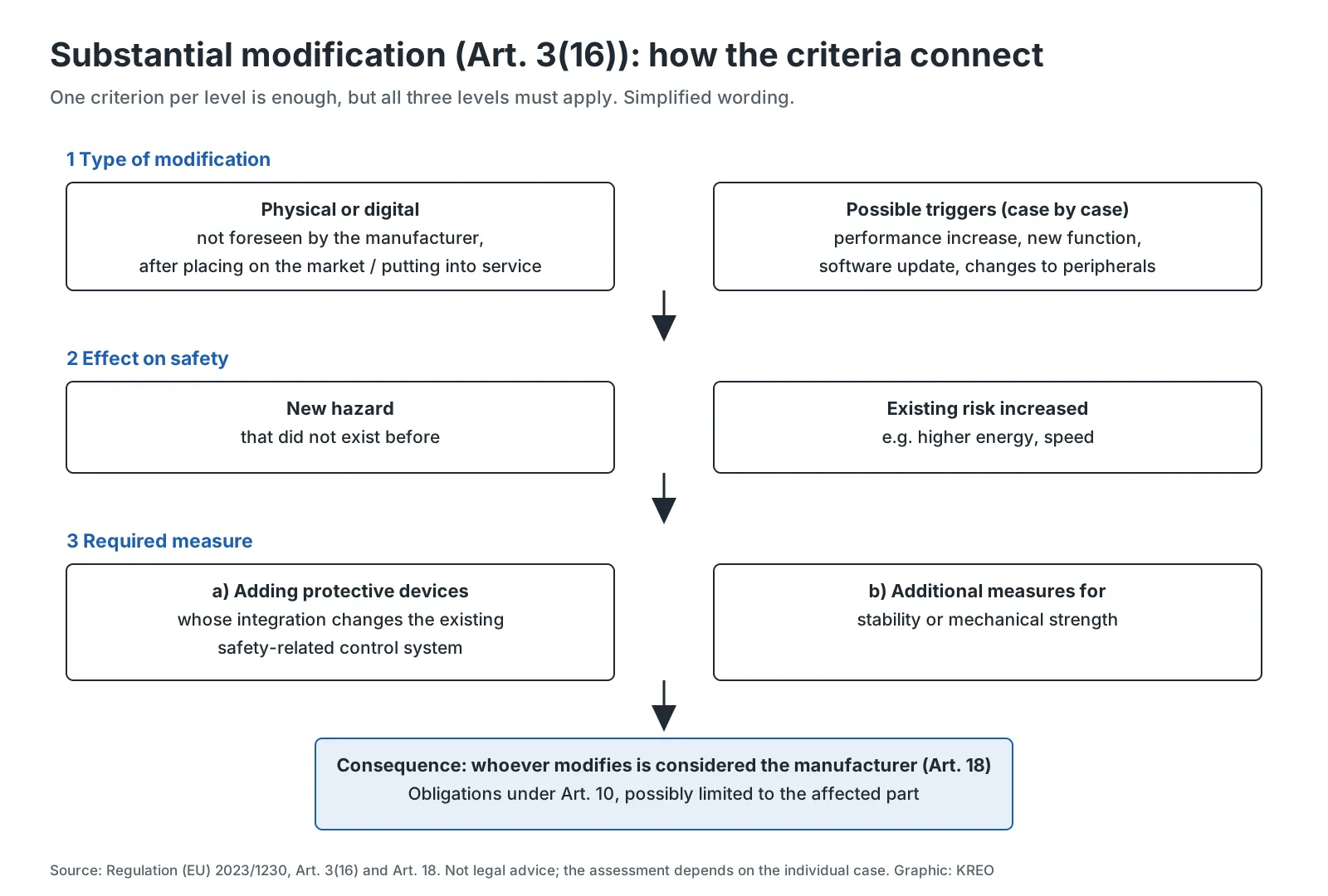
All three levels must apply. This explains why the assessment often turns out differently than you would expect at first glance.
Criterion 1: Not foreseen by the manufacturer
If the original manufacturer foresaw a conversion, such as an optional second clamping station or a speed level already covered in the instructions for use and the risk assessment, there is no substantial modification. The problem: for older lines, these documents are often incomplete. What the manufacturer “foresaw” is then hard to prove. Without the original risk assessment, there is also no baseline for the second level.
Criterion 2: New hazard or increased risk
This is where the real technical work lies. A new hazard arises, for example, from an additional axis, a new medium or a new point of access for the operator. An increased risk often arises unnoticed through physics. One example is a performance increase: the kinetic energy of a moving mass grows with the square of the speed, E = ½ · m · v². An axis that is 20% faster therefore moves about 44% more energy with the same mass.
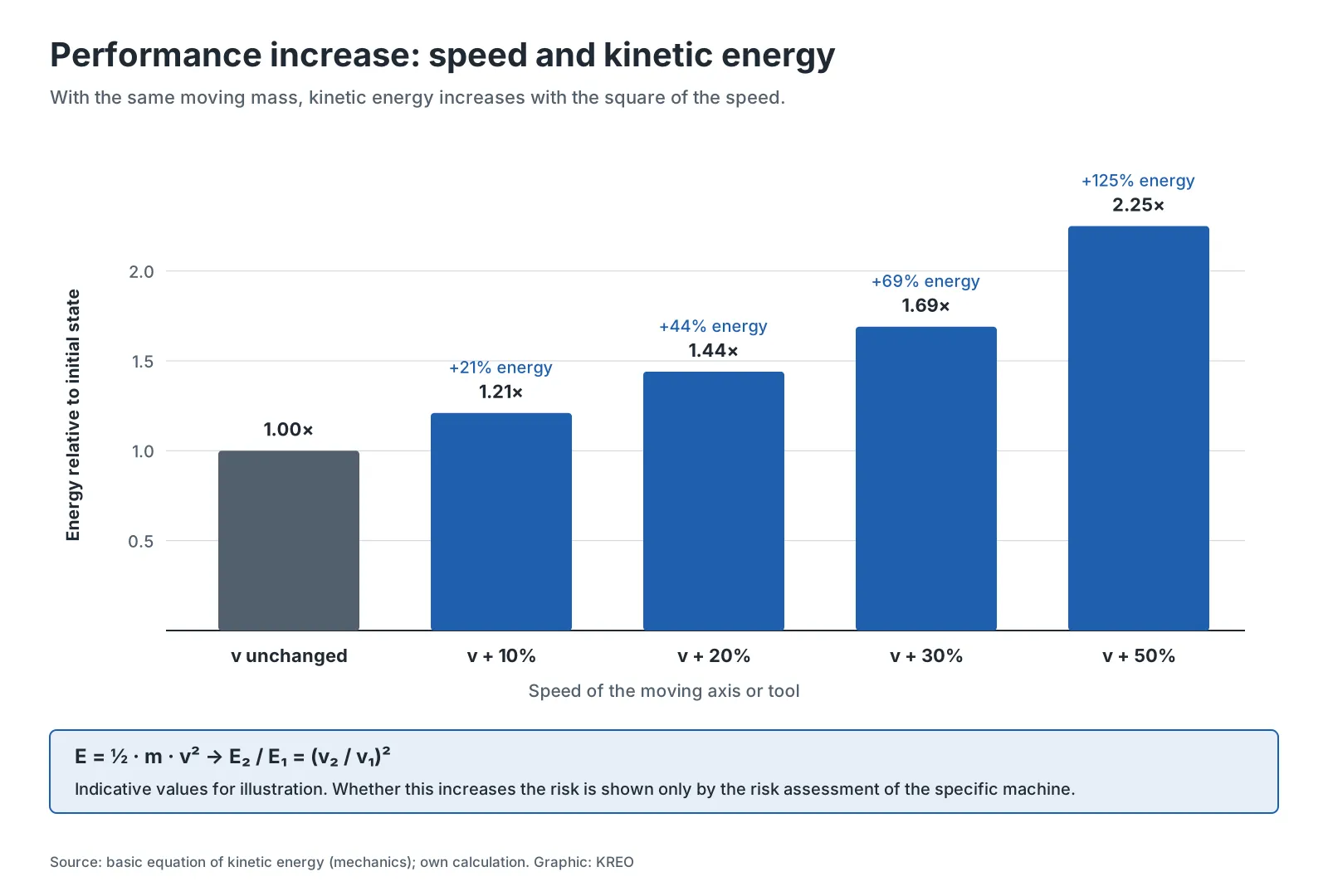
That does not yet mean the modification is substantial. It means the risk assessment has to show whether the existing protective measures can still handle the higher energy: whether a guard still withstands an ejected part, whether crushing forces are still within the permissible range, whether brakes and stopping behavior are still adequate.
Criterion 3: New protective measures affecting the safety control system or strength
The third level is decisive in the end. Even if a conversion introduces a new hazard, it is only substantial if one of the following two protective measures becomes necessary:
- A protective device that has to be integrated into the safety control system (point a). Examples are a new guard door with a position switch, an additional light curtain or a changed safety function in the control system.
- Reinforcement for stability or strength (point b). For example, the frame, foundation, guides or bearings have to be reinforced for higher loads.
If, on the other hand, the new hazard can be controlled with a simple measure, such as an additional bolted-on cover plate without any connection to the control system, the conversion is not substantial according to the wording of the Regulation. However, the risk assessment has to show that this simple measure is actually sufficient.
The safety distance shows how strongly a seemingly small intervention affects the protective device. According to EN ISO 13855:2024, the minimum distance of an electro-sensitive protective device from the hazard zone is calculated as S = (K · T) + DDS + Z. The symbols mean [2]:
- S is the minimum distance between the detection zone and the hazard zone in mm.
- K is the approach speed of the body part: 2000 mm/s for hand-arm movement or 1600 mm/s for walking speed.
- T is the overall system stopping time: the time from the interruption of the detection zone until the hazardous movement stops. It includes the response time of the protective device, the reaction time of the control system and the stopping time of the machine.
- DDS is the allowance for reaching into the detection zone. A light curtain only detects a hand or finger once it completely interrupts at least one light beam. Until then, the hand can already reach some distance beyond the plane of the detection zone toward the hazard zone. The size of this allowance depends on the resolution of the protective device, that is, the smallest object it reliably detects: the finer the resolution, the smaller the allowance.
- Z combines additional, application-dependent allowances, for example for measurement uncertainty in the stopping time or for a longer stopping time due to brake wear.
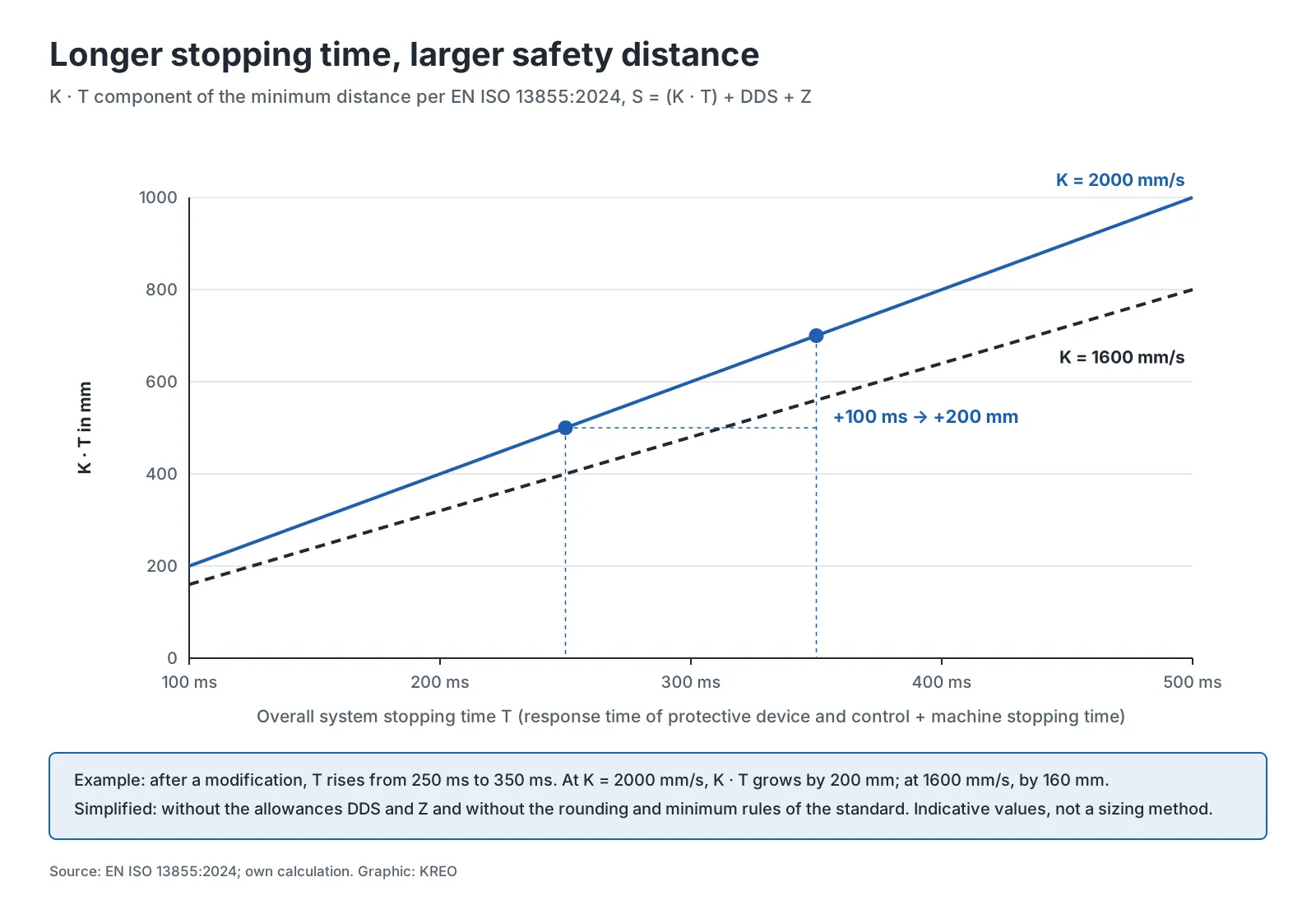
A calculation example for illustration: a new axis with a higher mass extends the overall system stopping time from 250 ms to 350 ms. At K = 2000 mm/s, the K · T component alone grows by 2000 mm/s · 0.1 s = 200 mm. If the existing light curtain does not have this margin, it has to be relocated or the stopping time has to be shortened again by design. The standard contains additional allowances as well as rounding and minimum rules that change the result in individual cases [2]. The calculation only shows the order of magnitude; it does not replace proper sizing.
This is exactly where borderline cases arise in practice: if the light curtain is only moved mechanically, the control system remains unchanged. If, however, a second detection plane or step-behind monitoring becomes necessary, the safety control system is affected.
Consequences: who becomes the manufacturer, and what has to be done?
Under Art. 18(1) of the Machinery Regulation, whoever carries out a substantial modification is considered the manufacturer and assumes the manufacturer’s obligations under Art. 10 [1]. That may be the operator who carries out the conversion itself. But it may also be the special machine builder or integrator who carries out the conversion on the operator’s behalf. Who exactly takes on the role of manufacturer should therefore be settled contractually before the conversion.
Under Art. 18(2), this person must ensure and declare under their sole responsibility that the machine meets the requirements of the Regulation, and apply the conformity assessment procedure under Art. 25(2) to (4) [1]. In practice, this means:
| Area | What is required after a substantial modification | What the effort depends on |
|---|---|---|
| Risk assessment | New for the modified machine, against Annex III of the Regulation | Quality of the existing original risk assessment |
| Conformity assessment | Procedure under Art. 25; stricter procedures apply to machinery listed in Annex I | Machine category, available standards |
| Technical documentation | New or updated, to be kept for at least ten years | Scope of the existing documentation |
| Instructions for use | Adapted to the modified machine | How much operation, setup and maintenance change |
| EU declaration of conformity and CE marking | New, with the modifier as the manufacturer | Who contractually takes on the role of manufacturer |
Source: Regulation (EU) 2023/1230, Art. 10, 18 and 25 [1]. The effort column is a classification, not an exhaustive list.
The scope: the entire machine or only the affected part?
For production lines, one detail in Art. 18(1) is important: if, according to the risk assessment, the modification only affects the safety of one machine within an assembly of machinery, the obligations apply only to that machine [1]. Recital 26 adds that for unaffected parts of an assembly, no tests have to be repeated and no new documentation has to be prepared [1].
This saves effort, but requires a clean delimitation. The risk assessment has to show comprehensibly why the modification at station 3 has no effect on stations 2 and 4. Shared emergency stop circuits, shared safety fences or a shared safety control system make this delimitation difficult. In linked production lines, this is the rule rather than the exception.
Old machine, new requirements
One consequence is often underestimated. Machinery placed on the market under the Directive before January 20, 2027 remains marketable (Art. 52) [1]. However, if such a machine is substantially modified after that date, the modified machine has to be measured against the requirements of the Regulation, not those of the Directive. This includes new points such as protection against corruption of the control system. For a 20-year-old line, the gap to the current state of the art can be large. In that case, it often makes economic sense to plan the conversion so that the threshold to a substantial modification is deliberately not crossed, or to plan the conversion comprehensively enough from the start that the new CE marking succeeds without rework. Both have to be decided before the design work, not afterward.
Typical borderline cases from practice
The following overview shows which question the assessment of common conversions hinges on. It deliberately does not classify whether a conversion is substantial, because the same type of conversion can go either way depending on the machine.
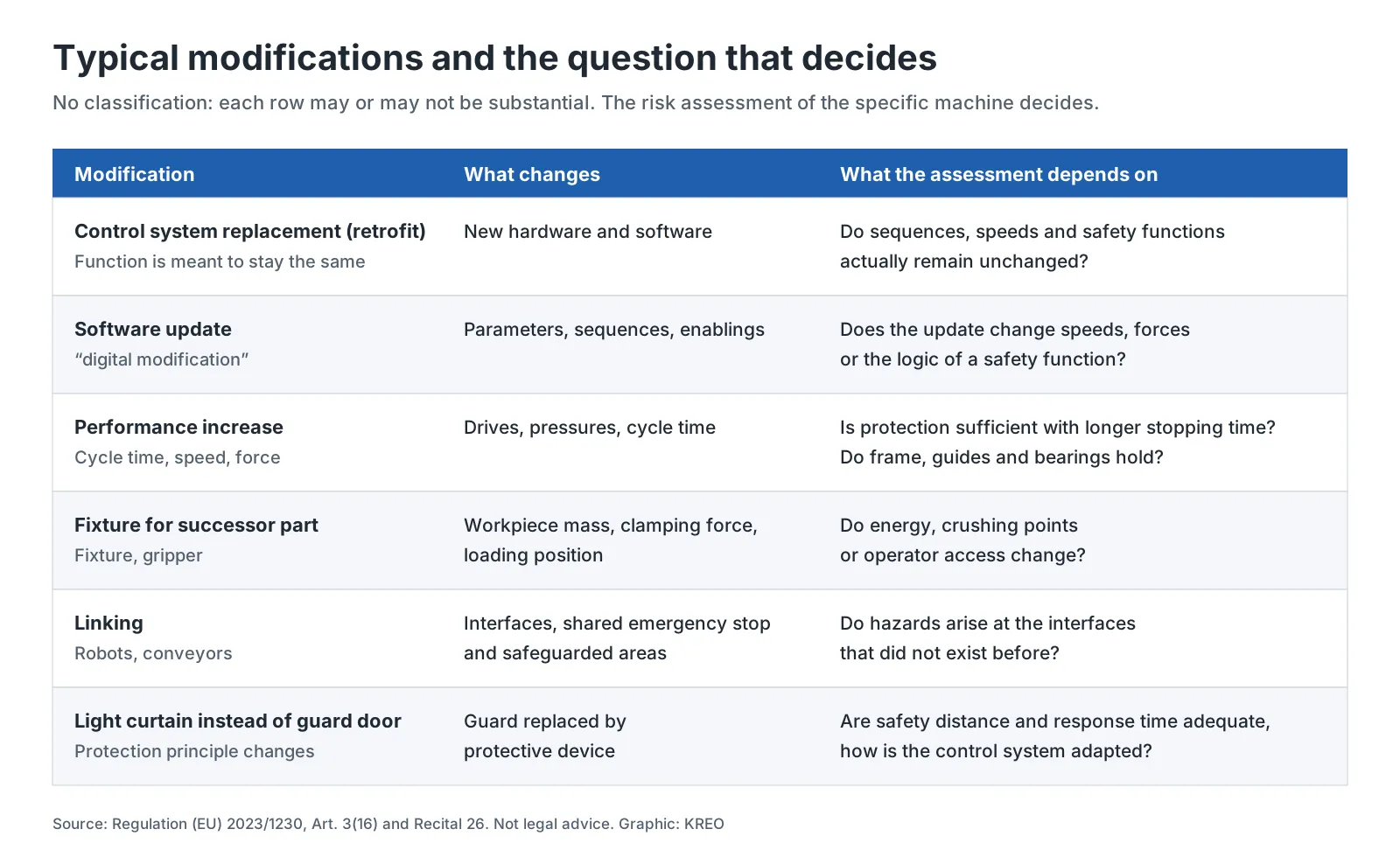
Control system replacement with the same function. A pure retrofit without a new hazard does not meet the definition if sequences and safety functions actually stay the same. In practice, however, details often change: a new generation of drives brakes differently, new software restarts differently after an emergency stop, an operator gets more ways to intervene. Regardless of the classification, the safety functions must demonstrably work again after the replacement. This validation according to EN ISO 13849 is a separate task, usually handled by the electrical designer.
Software update. The Regulation explicitly mentions digital modification [1]. An update that only changes the visualization has to be assessed differently from one that enables higher speeds or changes the logic of a safety function. I cover software updates in more detail in a separate article.
New fixture for a successor part. Typical in body-in-white production: the successor part is larger or heavier, the fixture is redesigned, clamping forces and loading positions change. Whether this creates a new hazard depends on whether crushing and shearing points, operator access or the moving masses change significantly.
Linking. When individual machines are connected to form a line, new hazards often arise at the interfaces. Whether this results in an assembly of machinery with its own conformity assessment is a separate question that I will cover in a later article.
Typical mistakes in the assessment and their consequences
Assessing only after the conversion. If the question is only asked at acceptance, design and procurement are already complete. If it then turns out that the modification is substantial, the risk assessment, the technical documentation and often design measures are missing. This delays commissioning, and changes to parts that have already been manufactured are more expensive than in the design phase.
Assessing without documentation. Even a result of “not substantial” should be justified in a traceable way. In the event of an accident or market surveillance, a documented justification is the only basis the operator can rely on.
Overlooking the sum of small changes. Many lines are modified in small steps: a faster cycle here, a new fixture there, a new software version later. Each change on its own may be uncritical. But if you only assess each one against the most recent state, you overlook that the machine may have moved far away from the originally assessed state.
Unclear manufacturer role. The operator and the company carrying out the conversion each assume that the other will take care of the conformity assessment. In the end, nobody has issued a declaration of conformity, even though the modification was substantial.
Why the assessment is always a case-by-case review
The definition in the Machinery Regulation is clearer than anything the Machinery Directive offered. However, it shifts the decision to a place where it cannot be answered across the board: the risk assessment of the specific machine. The same performance increase can have no consequences on one machine with generously dimensioned protective devices and require a new safety function on another. If you are planning conversions, you should therefore ask the question before the design work begins, while the threshold can still be influenced by design.
If you are planning to convert an existing machine, briefly describe your project to me. In the free initial meeting, we will clarify which questions arise for your conversion. You will receive a response within 24 hours on business days, followed by a quote for the assessment and, if you wish, for the mechanical design of the conversion. You can find more about our approach on the page CE marking for machinery. Get in touch